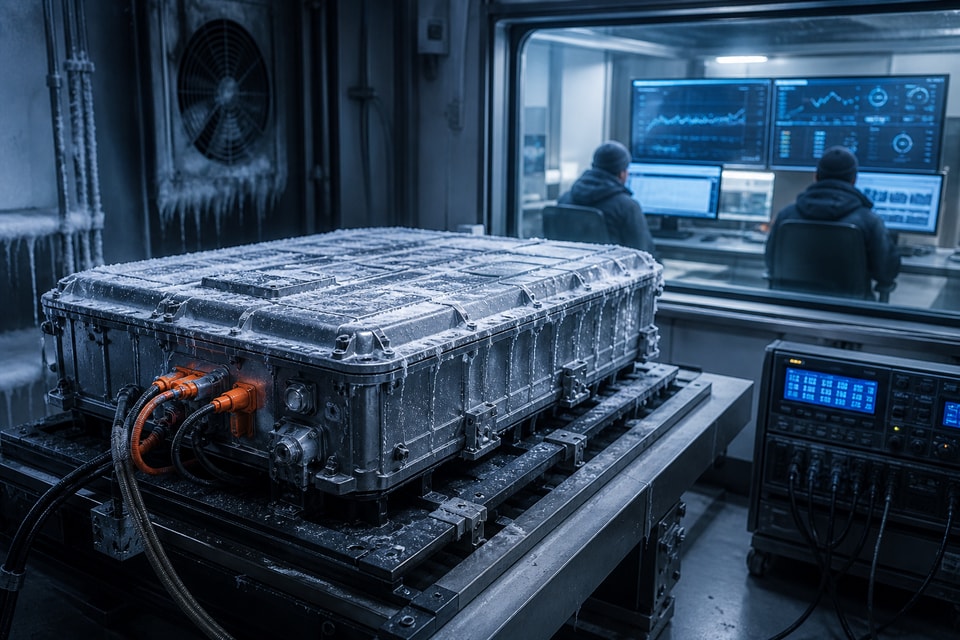
Designing Lithium Battery Systems for Reliable Sub-Zero Performance
Sub-zero operation changes how a lithium battery behaves. Electrochemical reactions slow, ionic transport becomes more difficult, internal resistance rises, and the same load can produce greater voltage sag than it would at room temperature. These effects do not mean that every cold-environment application requires the same solution. They mean the battery system must be designed around a defined temperature range, load profile, charging method, enclosure, and duty cycle.Understand What Cold Temperature ChangesAt low temperature, reduced power capability can become the immediate system constraint even when the pack still contains energy. A load step may pull terminal voltage toward an equipment cutoff, causing an early shutdown. Once the battery warms or the load is removed, voltage may recover, but that recovery should not be mistaken for full usable capacity under operating conditions.Charging deserves separate attention. The acceptable charging conditions of a cell chemistry and design are not automatically the same as its discharge conditions. Attempting to charge when the cells are colder than their permitted range can create safety and durability concerns. The battery management strategy should therefore distinguish cell temperature from ambient temperature and enforce charging rules based on verified cell conditions.Build Requirements from the Real Duty CycleA useful specification begins with the coldest expected cell temperature, not only the weather forecast. Storage duration, wind exposure, enclosure insulation, nearby heat sources, and operating schedule all affect the initial condition. Engineers should map the complete sequence: cold soak, startup, peak load, steady operation, idle periods, charging, and shutdown.Define minimum, typical, and maximum ambient conditions.Specify continuous current, pulse current, and pulse duration.Identify the equipment’s minimum input voltage and startup demand.Separate cold discharge requirements from cold charging requirements.Include reserve for aging, manufacturing variation, and heat loss.Clarify whether warm-up power comes from the battery or an external source.This sequence often exposes competing goals. Insulation can retain useful heat during operation but may slow cooling in warmer conditions. An internal heater can improve cell temperature before high load or charging, but it consumes energy and requires control logic. Capacity added to provide margin also adds volume, mass, and cost.Coordinate Thermal, Electrical, and Mechanical DesignCold-performance design is a system task. Cell selection should be supported by current paths with low and consistent resistance. Cables, connectors, fuses, busbars, and switching devices must be evaluated at low temperature because materials, contact behavior, and flexibility can change. Voltage sensing should remain accurate enough for protection and state estimation across the intended range.If heating is used, temperature uniformity matters. A sensor near a heater may report an acceptable value while cells farther away remain cold. Heater placement, insulation, thermal interfaces, and multiple sensing points can reduce this risk. Control logic should define when heating starts, the target range, the permitted load during warm-up, and the conditions under which charging may begin. Mechanical materials should also tolerate thermal cycling without creating pressure points, seal failures, or condensation pathways.Use Controls and Validation to Preserve MarginA battery management system can apply temperature-dependent current limits, block charging outside approved conditions, and report information to the host equipment. State-of-charge estimation may require compensation because voltage response and usable energy change with temperature and load. Conservative control thresholds should be based on tested behavior rather than room-temperature assumptions.Validation should combine cell or module characterization with complete-pack testing. Cold-soak the system long enough for temperatures to stabilize, then apply representative startup and operating profiles. Record individual cell-group voltages, pack voltage, current, sensor temperatures, heater consumption, and protection events. Repeat relevant tests at different states of charge and after suitable aging simulations or service accumulation. Verify transitions as well: moving equipment from cold storage into a warmer, humid environment can create condensation that the enclosure and operating procedure must address.Conclusion: Design for Temperature at System LevelReliable sub-zero performance depends on more than choosing a cell described as suitable for low temperatures. The electrical load, thermal architecture, charging controls, sensing, enclosure, and operating procedure must work together. Clear environmental requirements and representative cold-soak testing help engineers understand true usable power and energy before deployment.Developing a battery system for cold conditions? Send us your temperature range, current profile, charging scenario, installation constraints, and expected duty cycle. Our team can help review the key engineering inputs and discuss an appropriate architecture for further design and validation.
8/24, 2026

 UAV BatteryHigh-rate power for drones & UAVs
 Power Lithium BatteryHigh energy-density battery packs
 Industrial Lithium BatteryRugged cells for industrial use
 Energy Storage Batteries and SystemsGrid & residential ESS
 CellsCustom Li-ion / LiPo cells
 OEM/ODM and Technical ServicesCustom design & manufacturing
 MaterialsBattery material supply
 EquipmentLab & testing equipment